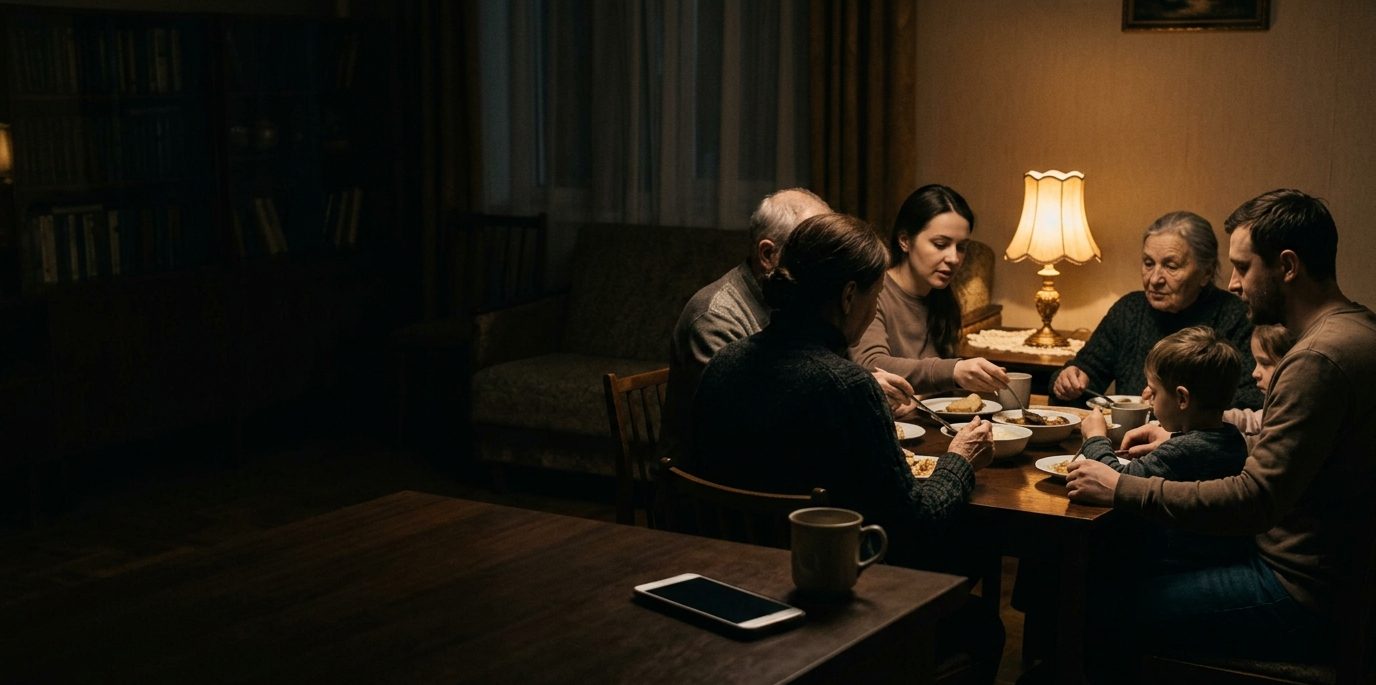
Most families who want a weekly ritual never hold the first one. Not because they don't care. Because they're waiting.
They're waiting for the week when everyone is home. When the teenager isn't at practice, the work trip is over, the grandparents are in town, and nobody is in a mood. They carry a picture of the whole family around the table, phones down, actually talking. It's a good picture. It's the picture we built Haklo to help families reach. But held as a requirement for starting, it's also the reason nothing happens.
The ideal quietly becomes the entry fee. And because the entry fee is so high, nobody pays it.
Why the big picture stalls you
In Switch, Chip and Dan Heath describe two sides of every person trying to change. There's the Rider, the rational part that knows what's good for us, and the Elephant, the emotional part that actually does the moving. The Rider can steer, but when the Elephant decides it isn't going anywhere, the Rider loses.
Your Rider already knows a weekly family gathering is worth it. Your Elephant looks at six schedules, three moods, and a Tuesday night that's already full, and decides tonight is not the night. Then next week isn't either.
The Heaths' answer is one of the most useful ideas in the book: shrink the change. When a change feels too big, people stall. So make the first step small enough that it doesn't feel like a change at all. Don't ask the Elephant to climb the mountain. Ask it to take one step.
For a family ritual, the full-family gathering is the mountain. The first step is smaller: whoever is willing, this week.
A ritual is defined by next week
We tend to judge a gathering by who was missing. That's the wrong measure.
What makes something a ritual isn't attendance. It's repetition. Two people sitting down on a Tuesday, and then again the following Tuesday, is a ritual. A perfect, fully attended evening that never happens again is just a nice night.
If you start with two and keep going, you have something. If you wait for everyone, you have a plan.
What starting small looks like
One parent and the youngest kid, before bedtime.
Grandma on speakerphone while the rest of the house is busy.
The two siblings who still get along this month.
You and your spouse, after the kids are asleep, practicing the format so it's easy to invite others later.
None of these is the ideal. Every one of them is a real start.
Small gatherings recruit
Here's what tends to happen next. The teenager who opted out hears about it at breakfast. The spouse who was "too busy" notices it happened anyway, and that it seemed to matter. Curiosity does work that invitations can't.
Switch calls this shaping the path: change the environment so the right behavior gets easier. Keep it on the same night. Keep it at the same time. Leave a chair open. You're not pressuring anyone to join. You're making it obvious that the door is open and the thing is real.
A gathering that already exists is far easier to join than one that's still being proposed.
The full table is the result, not the requirement
The whole family around the table is a worthy goal. It's just the wrong starting line.
Consistency produces the full table. It doesn't require it. The families who eventually get everyone there are almost never the ones who waited for everyone. They're the ones who started with whoever showed up and kept the thing going long enough for the others to come find it.
Is everyone together ideal? Yes. But life isn't ideal.
Start.
— Clay